
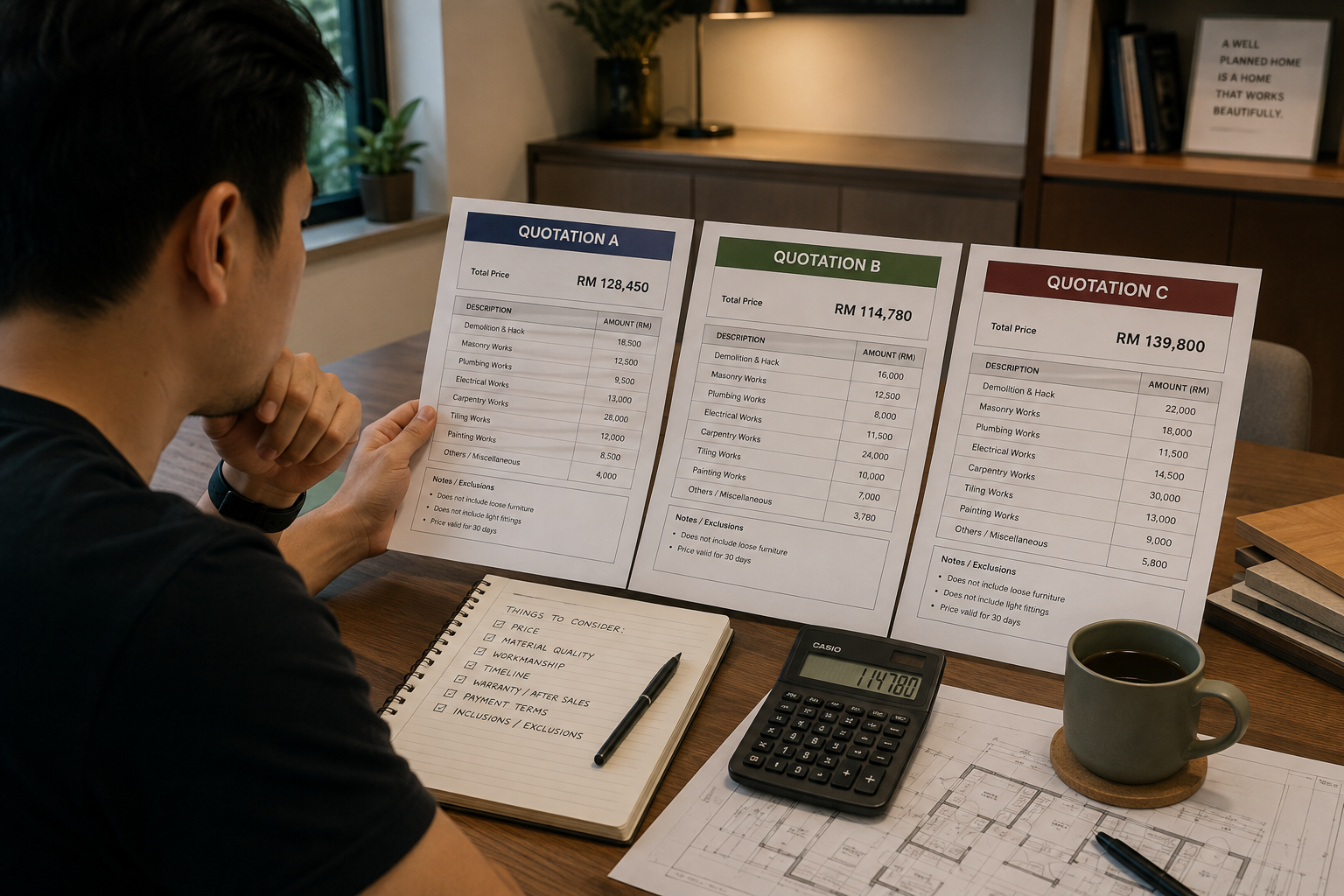
A friend and homeowner once showed me three quotes for the same renovation. Same house, same plan, same brief. RM185,000. RM230,000. RM260,000. His first instinct — most people's — was that someone was trying to cheat him.
Usually nobody is. They weren't quoting the same project. They were quoting three different readings of the brief and the expected end result. Unless you know how to read a quote, you can't tell which reading you're buying.
When you say "built-in wardrobe," you have one image in your head. The three people quoting you have three others.
One prices a melamine carcass with basic internals. One adds soft-close hardware and a proper internal layout. One prices a spray-painted finish that costs nearly double before you've touched the insides. All three lines read "Master bedroom built-in wardrobe, 8ft." All three are honest. They're also thousands of ringgit apart, multiplied across every carpentry item in the house.
Same with "plaster ceiling" (whole house, or living and dining only? Does it included cornices and/ or curtain pelmet?), "wiring" (new points, or reusing what's there?), and "painting" (how many coats, and does anyone come back after the carpenter scuffs the wall?). The cheapest quote is very often the shallowest reading of your brief.

The second reason is what isn't in the quote.
Provisional sums are placeholders for things not yet decided — tiles at a rate of RM5 per square foot, a lump sum for electrical points. Nothing wrong with them. But a quote can be made to look RM20,000 cheaper just by setting the placeholders low, and when you eventually pick a tile that exists in a real showroom, the difference lands on you as a variation order.
Exclusions are the small print at the back: debris disposal, haulage, protection works, plumbing relocation, authority submissions. One quote carries them in the line items. Another lists them as excluded, which is legitimate — as long as you noticed. The RM185,000 quote and the RM260,000 quote may contain almost the same eventual project. One of them just moved a chunk of it below the line.
This is why I'm careful about calling any quote expensive. The missing scope doesn't disappear. It comes back mid-project, one variation order at a time, at the moment you have no position left to negotiate from — the same thing I wrote about in Hacking isn't expensive. What comes after is.
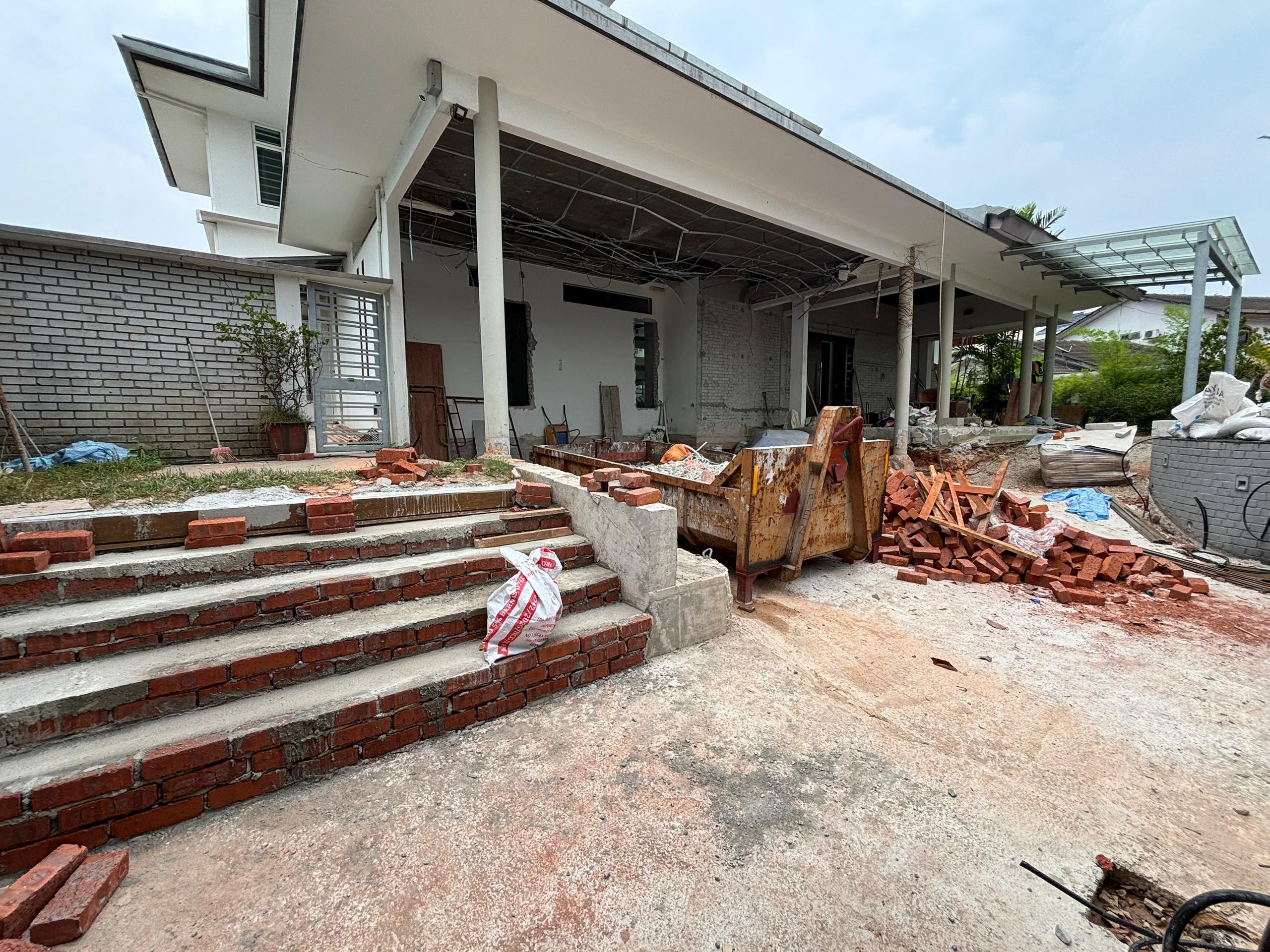
Two quotes can carry the same scope and still differ because of who ends up doing it.
Some firms run their own carpenters and site crew. Some subcontract every trade and coordinate. Some are effectively a middleman passing your job to a contractor with a margin added. Each model has a real cost structure behind it, and each produces a genuinely different number for identical work. None of them is wrong — but a quote built with in-house labour and a quote built with three layers of mark-ups are not comparable just because both say RM230,000.
Then there's the design fee. Some quotes carry it as a visible line. Others fold it into the construction cost and call the design free, which is why a "free design" quote can look competitive and still be the most expensive route once the build begins. If you can't see what the “thinking part” cost, you can't see what the “building part” cost either.
.jpeg)
The last set of differences never appears as a line item at all.
Time. A contractor who has assumed four months and one who has assumed seven months are pricing different amounts of supervision, site protection, and overhead. Preliminaries — hoarding, site power and water, cleaning, the running cost of simply having a project open — scale with duration, as mentioned in How long does a renovation actually take in Malaysia?
Risk. Everyone quoting an older house adds something for what they expect to find behind the walls. One party adds a real contingency and says so. Another quotes tight, wins the job, and recovers it through variation orders later. On paper, the second looks like the better deal as long as you don’t need to open up any walls.
Supervision. How often does someone senior actually walk the site? Is setting-out checked before tiling starts, or after you notice the drain falls the wrong way? A firm running fifteen concurrent projects and a firm running four are selling different products at the same material spec. That difference doesn't show up anywhere in the quote, and you'll live with it long after you've forgotten the 40% difference in price.

Say you fix everything above. Same spec, same inclusions, same model, same assumptions about time and risk. The three quotes still won't match — and they shouldn't.
A contractor is a business. It sets its margin the way any business does. It also carries a standard: a carpentry detail it won't drop below, a site it keeps clean, a phone it answers on a Sunday, a defect it comes back to fix a year later without an argument. All of that costs money to maintain, and all of it sits inside the number.
Two restaurants buy the same fish from the same supplier and charge very differently for it. Nobody finds that outrageous. You aren't only paying for the fish. You're paying for the kitchen, the training, the consistency, and whether the dish still comes out right on a bad night.
Renovation is the same. There is no correct price hiding underneath the three quotes, waiting to be found. There's a range, and each number tells you what standard that firm is willing to work to.

Don't compare totals. Compare readings.
Put the quotes side by side and go line by line. Where one has an item the others don't, ask why; the answer tells you who understood the brief. Ask each party to size their provisional sums — not remove them. A low quote carrying RM30,000 of placeholders is not a low quote. Ask who is doing the work, whether the design fee is in there, and how long they've think the job will take.
Then ask why a number is what it is. Anyone quoting your house should be able to account for every line: what it covers, what it assumes, what would change it. If the answer to "why is this RM18,000?" is "market price," you've learned something more useful than the price.
So don't read three quotes looking for the honest one. Read them to find out what each is actually selling — then decide what standard you want to build to.
A quote isn't really a price. It's a prediction of how your project will be run, written by the person who'll run it. Read it that way, and the 40% difference usually explains itself.